Chapter 1 — The Sign Came Down
When Ray Coleman lost his auto shop in Detroit, the bank removed the sign before he removed his tools.
He stood across the street and watched two workers unscrew the metal letters from the brick wall.
COLEMAN AUTO.
Twenty-three years.
Gone in less than fifteen minutes.
Ray had opened the shop when he was twenty-nine.
Back then, it had only one service bay.
One lift.
One old compressor.
And a toolbox his father had helped him buy.
By the time Ray turned fifty-two, the shop had three bays and customers who had been coming to him for more than a decade.
Some brought their children’s cars.
Some brought cars Ray had helped them buy years earlier.
Then one difficult year became two.
Parts became more expensive.
Commercial rent increased.
Two large repairs went unpaid.
One of Ray’s longtime mechanics left for a dealership that offered benefits Ray could not match.
Then the transmission supplier he used changed payment terms.
Ray borrowed money.
He told himself it was temporary.
Then he borrowed again.
The shop stayed busy.
The bank account did not.
By the time Ray admitted how bad things had become, the building owner had already sent the final notice.
Ray sold equipment.
Paid employees first.
Paid what he could to suppliers.
Then handed back the keys.
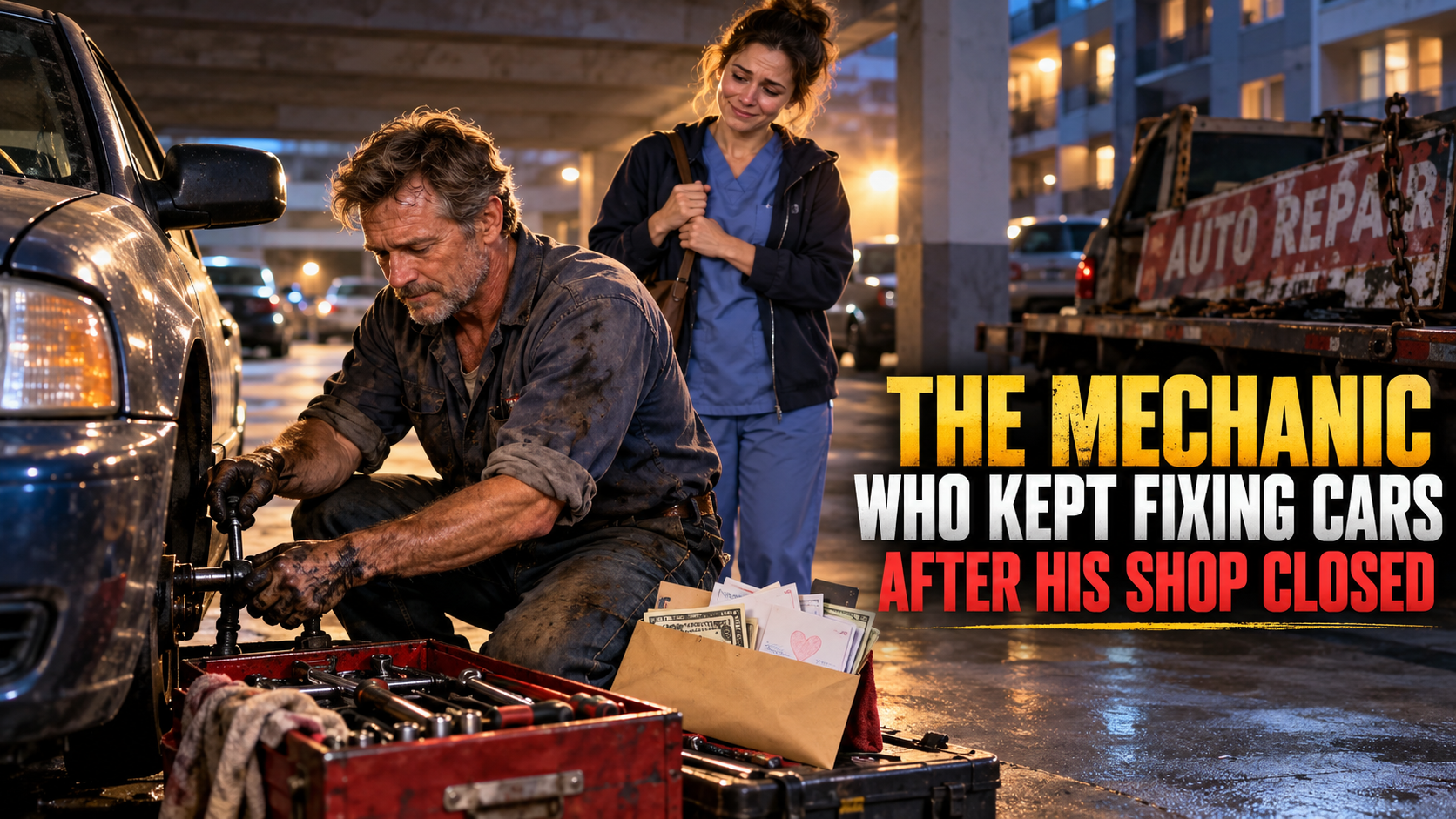
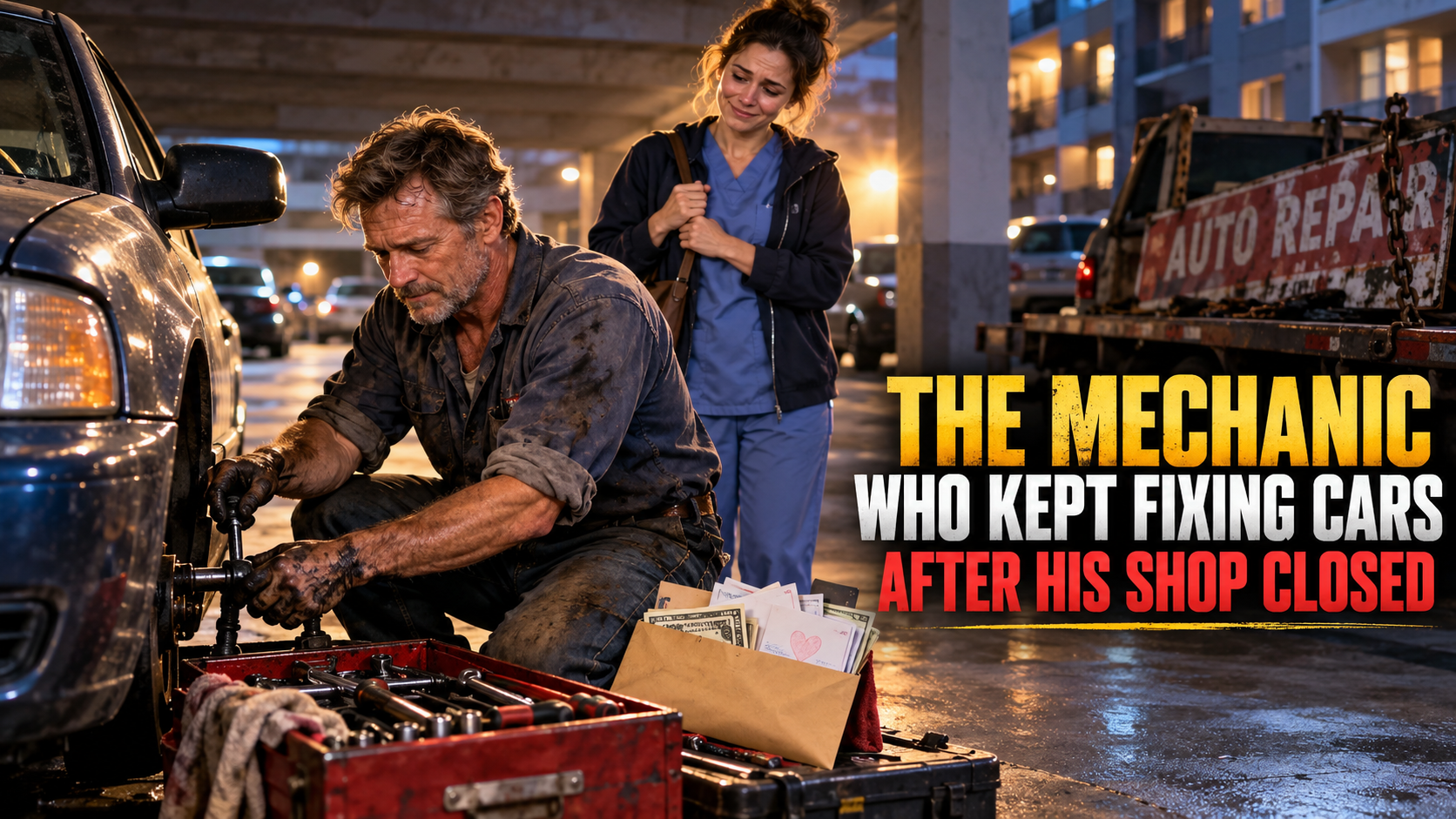
He moved everything he still owned into the parking garage beneath his apartment building.
Two tool chests.
A floor jack.
Jack stands.
An air compressor too small for serious shop work.
Boxes of parts nobody wanted.
That was all.
Ray told everyone the same thing.
“I’m done.”
His sister did not believe him.
His former customers did not believe him.
Ray barely believed himself.
But three days after the shop closed, he woke at six in the morning with nowhere to go.
For the first time in twenty-three years, nobody was waiting for him to open a garage door.
He sat in his kitchen until almost noon.
Then someone knocked.
Ray ignored it.
The knock came again.
He opened the door.
Tanya Brooks stood in the hallway wearing blue hospital scrubs.
Ray knew her from the building.
Third floor.
Single mother.
Night-shift nurse.
She looked exhausted.
“Sorry.”
Ray frowned.
“What happened?”
“My car won’t start.”
Ray looked at her.
Tanya continued.
“I called a tow company.”
“How much?”
“One eighty-five just to get it to a shop.”
Ray sighed.
“What’s it doing?”
“Nothing.”
“Nothing means what?”
She thought.
“Clicks.”
Ray closed his eyes.
Then looked toward the hallway.
“I’m not running a shop anymore.”
“I know.”
Tanya nodded.
“I just thought maybe you could tell me if it’s something simple.”
Ray stared at her for another second.
Then he grabbed his toolbox.
Chapter 2 — The First Car
Tanya’s car was parked on the lowest level of the garage.
A twelve-year-old Ford sedan.
Ray opened the hood.
He checked the battery.
Then the terminals.
One connection was badly corroded.
He cleaned it.
Tightened it.
Told Tanya to try again.
The engine started immediately.
Tanya laughed.
“That’s it?”
“That’s it.”
She looked almost embarrassed.
“How much?”
“Nothing.”
“Ray.”
He closed the hood.
“I said nothing.”
“You came all the way down here.”
“I live upstairs.”
“You still did work.”
Ray picked up his toolbox.
“Go home and sleep.”
Tanya watched him walk toward the elevator.
Two days later, somebody left a bag of groceries outside Ray’s door.
No note.
He knew exactly who it was.
He knocked on Tanya’s apartment.
She opened the door.
Ray held up the bag.
“I said nothing.”
Tanya smiled.
“And I didn’t give you money.”
“That’s not the point.”
“Good night, Ray.”
She closed the door.
Ray stood there annoyed for almost a minute.
Then took the groceries home.
That should have been the end.
It was not.
A week later, a college student from the fifth floor knocked.
His brakes were squealing.
Ray checked them in the garage.
The pads were nearly gone.
He showed the kid exactly what needed to be replaced.
The student looked worried.
“How much?”
Ray shrugged.
“Buy the parts.”
“I mean labor.”
“Buy the parts.”
The following Saturday, Ray installed them.
Then came Mr. Lewis from the second floor.
Dead battery.
Then a delivery driver Tanya knew from the hospital.
Leaking coolant hose.
Then a woman from the next building whose car kept overheating.
Ray kept saying the same thing.
“I’m not running a business.”
Nobody argued.
They just kept bringing cars.
Chapter 3 — Because My Hands Still Work
Within a month, the corner of the apartment garage near Ray’s parking space looked suspiciously like a small repair shop.
Not a real one.
No sign.
No lift.
No office.
No waiting room.
Just tools.
Cardboard boxes.
Old towels.
And Ray.
People started leaving coffee beside his toolbox.
Someone brought him a folding chair.
Another neighbor gave him a used work light.
Ray complained about all of it.
Then used everything.
One evening Tanya returned from work and found Ray lying beneath an old Buick.
The owner was an elderly man named Mr. Howard.
Ray was replacing a damaged exhaust bracket.
Tanya leaned against a concrete pillar.
“You know you lost your shop.”
Ray’s voice came from beneath the car.
“Yep.”
“You’re still fixing everybody’s cars.”
“Apparently.”
Tanya crossed her arms.
“Why?”
Ray slid out.
His shirt was dusty.
His hands were black with grease.
For a moment, he looked at them.
Then he said:
“Because my hands still work.”
Tanya did not answer.
Ray wiped his hands on a rag.
“The shop closed.”
He shrugged.
“My hands didn’t.”
That sentence stayed with her.
Ray forgot he had even said it.
Chapter 4 — What Ray Had Lost
The truth was Ray missed more than the business.
He missed being needed.
For twenty-three years, people had come to him with problems.
Strange noises.
Warning lights.
Cars that would not start.
Ray liked problems with mechanical answers.
A belt could be replaced.
A hose could be patched.
A bad alternator could be tested.
Even expensive problems usually had a reason.
Losing the shop felt different.
There was no single broken part.
No tool that could repair debt.
No socket wrench for rent.
No diagnostic machine that could tell him exactly where everything had gone wrong.
Ray blamed himself.
He replayed decisions constantly.
Maybe he should have raised prices earlier.
Maybe he should have moved.
Maybe he should have borrowed less.
Maybe more.
Maybe he should have sold before things got bad.
His former employee Marcus called once.
“You okay?”
Ray gave the usual answer.
“Fine.”
“You working?”
“No.”
That was technically true.
Ray did not call what happened in the parking garage work.
There were no invoices.
No appointments.
No shop hours.
But every week more people came.
Eventually Tanya started keeping track.
Ray noticed one evening.
She was writing names in a notebook.
“What are you doing?”
“Nothing.”
“That looks like something.”
Tanya closed the notebook.
“Go fix the car.”
Ray narrowed his eyes.
But he did.
Chapter 5 — The Money He Refused
People tried to pay Ray.
He usually refused.
That became an argument.
One man left forty dollars inside Ray’s toolbox.
Ray returned it.
A woman placed twenty dollars beneath his windshield wiper.
Ray found her apartment and gave it back.
Tanya finally confronted him.
“You know this is becoming ridiculous.”
Ray looked up from a battery charger.
“What?”
“You won’t let anybody pay you.”
“I’m not a business.”
“You still need money.”
“That’s my problem.”
Tanya sighed.
“You’re helping people who would otherwise pay a shop.”
“That doesn’t mean I need to take it.”
“Why?”
Ray looked irritated.
Because taking money made it real.
If he charged people, then this became work.
If it became work, then he had to admit he still wanted to be a mechanic.
And if he admitted that—
he had to admit losing the shop had not changed the thing he loved.
Only where he did it.
Ray did not explain any of that.
He simply said:
“I don’t take charity.”
Tanya stared at him.
“I didn’t say charity.”
Ray turned away.
The conversation ended.
But Tanya did not forget it.
Chapter 6 — Bay Number Three
Four months after Coleman Auto closed, Tanya knocked on Ray’s door again.
This time she was not wearing scrubs.
“Come with me.”
Ray frowned.
“Where?”
“You’ll see.”
“I hate when people say that.”
“Good.”
She drove.
Two miles away, they stopped in front of an old neighborhood garage.
The building had seen better days.
Faded paint.
Three service bays.
One small office.
A hand-painted sign that had not been updated in years.
The owner, Frank Russo, met them outside.
He was in his late sixties.
He shook Ray’s hand.
“I know your name.”
Ray looked suspicious.
“That usually isn’t good.”
Frank laughed.
“Depends.”
He raised one garage door.
Bay Three was empty.
No lift.
No tools.
Just concrete floor and fluorescent lights.
Ray looked at Tanya.
“What is this?”
Tanya handed him a folder.
Ray did not open it.
“No.”
“You don’t even know what it is.”
“I know your face.”
“Open it.”
Ray did.
Inside were envelopes.
Dozens of them.
Twenty dollars.
Thirty.
Fifty.
One hundred.
Each envelope had a name written on it.
Tanya Brooks.
Mr. Lewis.
Marcus Hill.
Jenna Price.
Howard Collins.
People Ray had helped.
People from the building.
People from outside it.
Ray looked at Tanya.
His face hardened.
“I told you I don’t take charity.”
Tanya nodded.
“Neither did we.”
She pointed toward the folder.
“These are repair bills.”
Ray looked at her.
“What?”
“I asked everyone what they thought your work was worth.”
Ray stared at the envelopes.
Tanya continued.
“They wrote down what they would have paid another mechanic.”
“No donations.”
“No gifts.”
“No pity.”
Ray looked toward Frank.
The garage owner nodded.
“It’s enough for two months on this bay.”
Ray sat down on an overturned bucket.
For a moment, he said nothing.
Then he looked through the envelopes again.
Every name had a number.
Every number belonged to a job he remembered doing.
Brake pads.
Battery.
Starter.
Alternator.
Coolant hose.
Wheel bearing.
Nothing given for free anymore.
Tanya leaned against the wall.
“You said your hands still work.”
Ray looked at his hands.
She continued.
“So let them.”
Chapter 7 — Starting Smaller
Ray rented Bay Three.
Only Bay Three.
He refused to call it a comeback.
Tanya called it whatever she wanted.
Frank let him use one old lift until Ray could afford his own.
Ray brought in his toolboxes.
The work light from the garage.
The folding chair.
Even the small compressor.
On the first morning, Ray arrived at 6:30.
He stood outside the bay for almost ten minutes.
There was no sign above it.
No employees.
No waiting room.
Nothing that looked like the business he had lost.
Then Tanya pulled in.
Her car was making a strange noise.
Ray laughed.
“You planned this.”
“Maybe.”
He opened the hood.
That became his first official job.
He charged her.
She made sure of it.
The second customer was Mr. Lewis.
Then the college student.
Then the delivery driver.
Word spread again.
Only this time, Ray stopped fighting it.
He printed simple invoices.
He opened a business account.
He bought insurance.
He registered the name.
Coleman Auto.
Again.
Not because he was trying to rebuild the exact shop he lost.
Because he finally understood he did not need the old building to keep doing the work.
Chapter 8 — One Bay Became Two
The first year was slow.
Ray was careful.
No unnecessary loans.
No expensive equipment unless it paid for itself.
No pride when he needed help.
That last part was hardest.
Tanya helped with paperwork on weekends.
Ray paid her.
She argued about the amount.
Ray won.
Marcus, his former employee, started helping Saturdays.
Six months later, Ray rented Bay Two as well.
A year later, Frank told him he was retiring.
He offered Ray first chance at the entire garage.
Ray nearly said no.
Then he looked at the numbers.
Really looked.
This time, the business could support it.
He bought nothing he could not afford.
Two years after Coleman Auto closed, another Coleman Auto existed.
Smaller.
Simpler.
Healthier.
A new sign hung above Bay Three.
Ray insisted on putting it there instead of over the entire building.
Tanya asked why.
“That’s where it started.”
Ray corrected her.
“No.”
She looked confused.
Ray smiled.
“That’s where it started again.”
Chapter 9 — The Young Mechanic
One afternoon, a nineteen-year-old mechanic named Devon started working with Ray.
Devon was talented.
Fast learner.
Terrible at cleaning tools.
Ray complained daily.
Devon ignored most of it.
One evening, they closed late after replacing an engine mount.
Devon looked around the garage.
“I heard you had a bigger shop before.”
Ray nodded.
“Three bays.”
“This has three bays.”
“The old one was nicer.”
Devon laughed.
“Then how did you rebuild?”
Ray wiped his hands.
“I didn’t.”
Devon looked confused.
“You literally did.”
Ray shook his head.
He pointed through the open garage door toward the parking lot.
Tanya’s car was outside.
Mr. Lewis’s truck beside it.
Another customer waiting.
Ray said:
“I just kept being useful after I lost the place where I used to be useful.”
Devon became quiet.
Ray continued.
“People confuse the building with the work.”
He looked around.
“I did too.”
Then he picked up a wrench Devon had left on the floor.
“And if you leave my tools like this again, you can rebuild your career somewhere else.”
Devon laughed.
“Got it.”
Chapter 10 — The Sign
Years later, Ray still kept the old Coleman Auto sign.
The one the bank had removed.
He found it in storage after the building was sold.
The metal was bent.
Paint scratched.
One letter was missing a corner.
Tanya asked why he kept it.
Ray shrugged.
“For perspective.”
The old sign eventually hung inside the new garage.
Not outside.
Customers sometimes asked about it.
Ray rarely told the entire story.
He would simply say:
“Old shop.”
But Tanya knew.
So did Marcus.
So did the people whose names had once filled that folder.
Ray had believed losing his business meant losing the part of himself that mattered.
The shop closed.
The debt remained.
The sign came down.
But then a nurse needed her car to start.
A student needed safe brakes.
An old man needed a battery.
And Ray still knew how to help.
That was enough to begin again.
Not with investors.
Not with a miracle.
Not with someone handing him a new garage.
With one toolbox.
One parking space.
One neighbor.
Then another.
And another.
The business returned only after Ray stopped trying to prove he still had one.
He simply kept doing useful work.
Eventually, people built the business back around him.
And that was the lesson Ray carried for the rest of his life.
Sometimes losing the place where you were useful does not mean you lost your value.
Sometimes it only means you have to discover whether the thing people needed from you was ever the building at all.
WATCH THE FULL VIDEO
Video is ready to play. If one link doesn't work, try another available link below 👇
WATCH THE FULL VIDEO
Video is ready to play. If one link doesn't work, try another available link below 👇