KAREN BLOCKED A BIKER FROM PARKING — THEN HE ASKED “WHO PUT THESE CONES HERE?”
PART 1 — CUSTOMERS ONLY
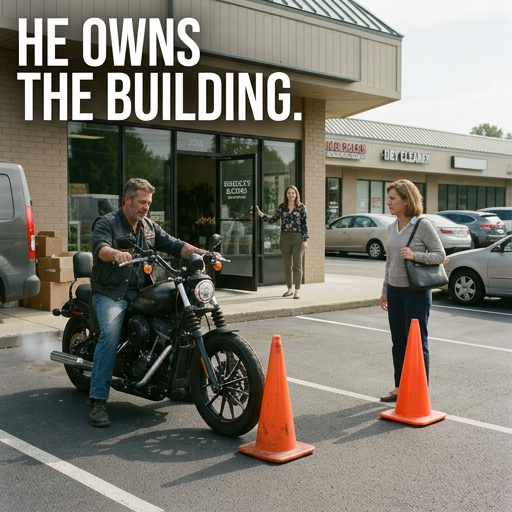
Dean Whitaker was halfway into an empty parking space when a woman dragged an orange cone in front of him.
He stopped the motorcycle.
Both boots hit the pavement.
“Customers only.”
Dean looked at the cone.
Then at the woman.
“I’m parking.”
“Not here.”
A second cone occupied the next space.
Dean pointed toward them.
“Who put these out?”
The woman adjusted the strap of her handbag.
“I did.”
Before Dean could answer, a shop door opened.
“Mr. Whitaker?”
PART 2 — THE OWNER
Rebecca Monroe hurried out of the flower shop.
Dean nodded.
“Morning.”
The woman beside the cones frowned.
“You know him?”
Rebecca stared at her.
“He owns the building.”
For the first time, Paula Denton stopped talking.
Dean did not smile.
He looked down at the cones.
“These the ones you called me about?”
Rebecca nodded.
“Every morning.”
Paula folded her arms.
“They’re for my customers.”
Dean looked at her.
“Your customers?”
“My salon gets busy.”
“Your salon has one space.”
PART 3 — THREE WEEKS
Rebecca stepped closer.
“She blocks our deliveries too.”
Dean turned.
“How long?”
“Three weeks.”
Paula shook her head.
“It’s only two spaces.”
Dean slowly pulled off one riding glove.
“That’s not what your lease says.”
Paula’s face tightened.
“I’ve been here four years.”
“I know.”
“Then you know we need parking.”
Dean looked at her.
“And parking isn’t why I came.”
That was the first moment Paula looked genuinely worried.
PART 4 — THE STRIP
Dean and his brother had bought the strip center twelve years earlier.
It was not glamorous.
Eight storefronts.
A roof that always needed something.
Plumbing from three different decades.
Dean had spent most of his career as an electrician.
Owning the building had not changed him much.
He still changed lights himself.
Still knew where every breaker panel was.
Still answered tenant calls personally when something broke.
Rebecca ran the flower shop.
Paula managed the salon two doors down.
For years, there had been almost no trouble.
Then the complaints started.
PART 5 — THE FIRST COMPLAINT
Rebecca was the first to call.
Her wholesalers delivered flowers before noon.
Twice, delivery vans found the nearest spaces blocked by cones.
Drivers had to carry boxes farther across the lot.
Rebecca moved the cones.
The next morning they were back.
She asked Paula about them.
Paula said her clients needed convenient parking.
Rebecca pointed out the lot was shared.
Paula said:
“My customers actually spend money here.”
Rebecca remembered that sentence.
She also remembered deciding not to argue.
She called Dean instead.
PART 6 — NOT JUST PARKING
The second complaint came from the bakery.
Paula had begun telling salon customers they could use the bakery’s curbside pickup area.
Then someone from the dry cleaner complained.
Packages left outside their rear door had been moved because Paula wanted the service walkway clear for a salon promotion.
Nothing was catastrophic.
That was part of the problem.
Every individual incident seemed too small to start a war over.
A cone.
A delivery.
A walkway.
A customer being redirected.
But three tenants were now describing the same pattern.
Paula had begun treating shared property as if it belonged to her business.
PART 7 — WHY DEAN CAME
Dean had not driven across town to argue about two parking cones.
He came because Rebecca forwarded him an email Paula had sent to neighboring tenants.
The message announced new parking “rules.”
Paula had created them herself.
She had no authority to do that.
The email claimed certain shared spaces were now reserved for salon clients.
It also warned other businesses not to interfere.
Dean read it twice.
Then called his brother.
“Did you approve this?”
“No.”
Neither had the property manager.
So Dean got on his motorcycle.
And drove over.
PART 8 — THE OFFICE
Dean asked Paula to come inside the vacant management office.
Rebecca stayed outside.
So did the other tenants.
Dean did not want a public spectacle.
He placed a printed copy of Paula’s email on the desk.
“Did you send this?”
Paula looked at it.
“Yes.”
“Who told you these rules were approved?”
“Nobody.”
“Then why did you say they were?”
Paula took a breath.
“Because nobody was doing anything.”
Dean leaned back.
“About what?”
“My customers complain about parking.”
“So you took spaces from everybody else?”
“I solved the problem.”
Dean shook his head.
“You moved the problem onto your neighbors.”
PART 9 — THE CHOICE
Dean did not evict Paula.
Not that day.
He gave her a written notice.
The cones were removed immediately.
The fake parking rules were withdrawn.
The salon had to stop directing customers into other tenants’ designated service areas.
And Paula had to send a correction to every tenant she had emailed.
Paula hated that last part most.
She wanted Dean to send it.
He refused.
“You wrote the first email.”
“You write the second one.”
For nearly a minute, Paula said nothing.
Then she nodded.
It was not dramatic.
No cheering crowd.
No police.
No viral public humiliation.
Just accountability written in plain language.
PART 10 — TWO SPACES
A month later, Dean returned.
No cones.
Rebecca’s delivery van was parked close to her shop.
The bakery’s curbside area was clear.
Salon customers were still finding places to park.
Some walked twenty extra yards.
The world had survived.
Paula saw Dean outside.
She approached him.
“I thought you were going to terminate our lease.”
Dean shrugged.
“Were you planning to keep doing it?”
“No.”
“Then I had better options.”
Paula looked around the lot.
“I really thought I was helping my business.”
“I know.”
“That doesn’t make it better.”
“No.”
She nodded.
Then glanced toward the space where they had first met.
“Still think it was ridiculous over two parking spaces?”
Dean smiled slightly.
“It was never about two spaces.”
That was the part people misunderstood.
Paula had not nearly lost her lease because of traffic cones.
She had created rules for property she did not control.
Then expected every neighboring business to accept them.
The cones were simply the first thing everyone could see.
The real problem was what they represented.
Paula had slowly stopped asking:
“Is this shared?”
And started assuming:
“Can I take it?”
Sometimes entitlement does not arrive loudly.
Sometimes it appears one orange cone at a time.
WATCH THE FULL VIDEO
Video is ready to play. If one link doesn't work, try another available link below 👇
WATCH THE FULL VIDEO
Video is ready to play. If one link doesn't work, try another available link below 👇