Chapter 1 — The Hotel
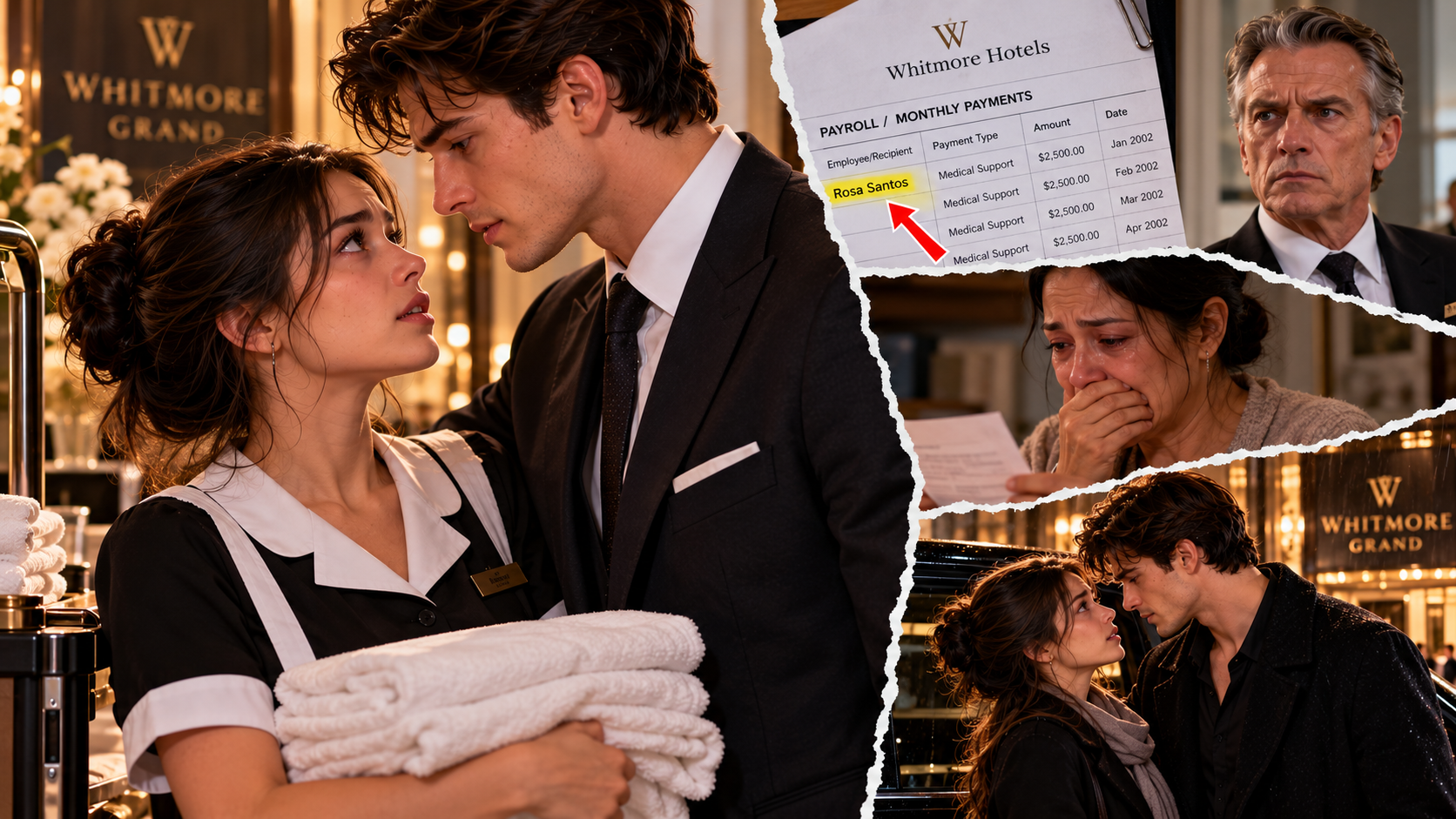
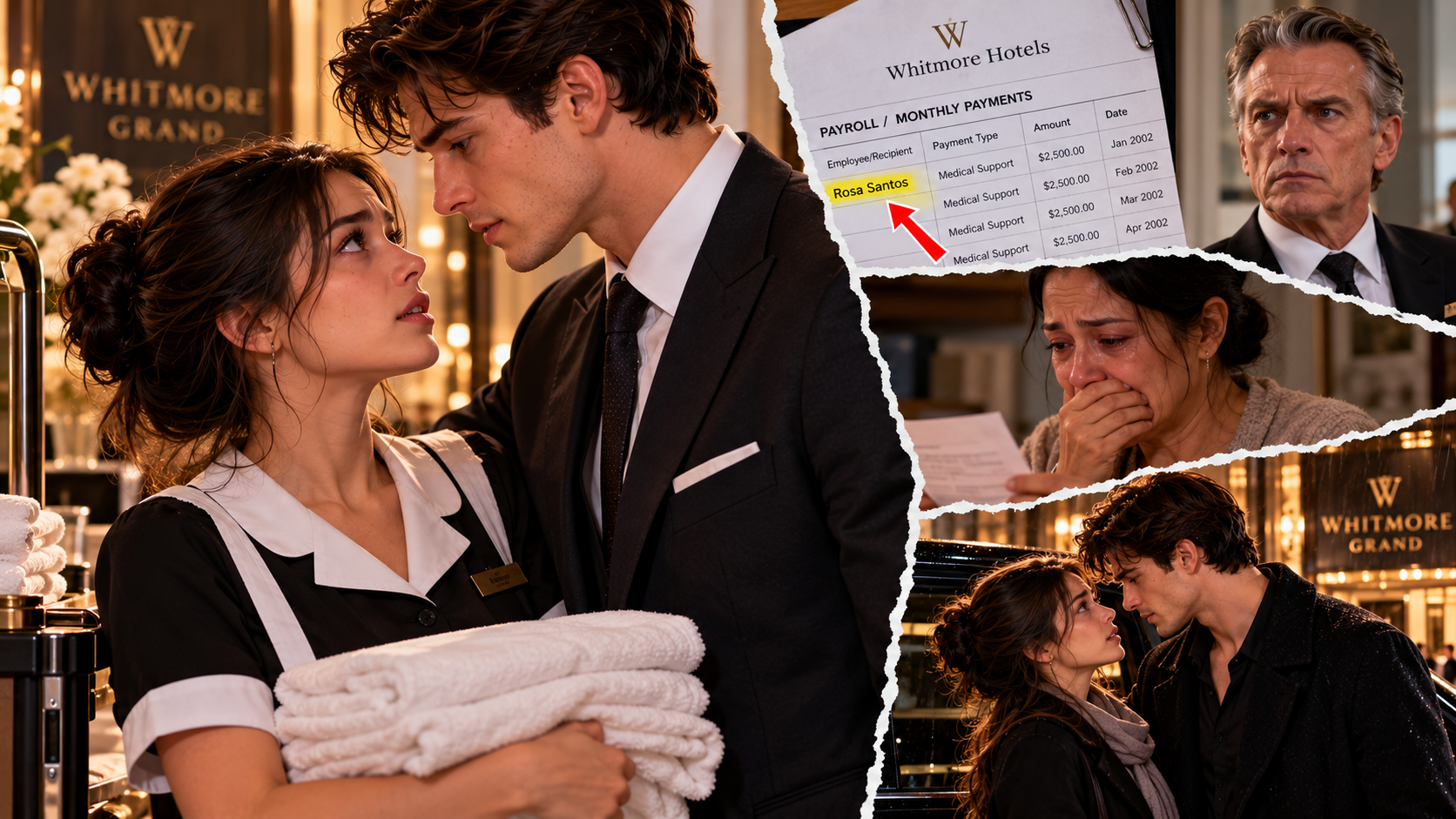
Maria Santos worked nights at the Whitmore Grand while finishing nursing school.
Housekeeping paid tuition slowly.
Very slowly.
Jonathan Whitmore first noticed her because she argued with him.
He left a conference room covered in coffee cups after a late meeting.
Maria pointed toward the mess.
“You know people have to clean this.”
Jonathan stopped.
“I know.”
“Apparently not.”
He helped.
That surprised her.
Then he returned the next night.
And the next.
Jonathan was twenty-nine.
Son of hotel owner Edward Whitmore.
Future heir.
Maria was twenty-six.
Daughter of a disabled former construction worker.
They had almost nothing in common.
They dated anyway.
Quietly at first.
Maria refused expensive gifts.
Jonathan found that annoying.
She found his annoyance entertaining.
Then Maria discovered her mother’s name in a company file.
Monthly payments.
Every month.
For twenty-three years.
Chapter 2 — The Payroll
Maria confronted her mother.
Rosa became pale.
“Where did you see that?”
“At Whitmore.”
Rosa sat.
Maria waited.
Her father, Luis, had worked construction on a Whitmore hotel twenty-three years earlier.
A scaffold collapsed.
Several men were injured.
Luis survived.
But spinal damage permanently limited his ability to work.
The investigation found safety failures.
Before the case became public, Whitmore representatives approached several families.
Private settlements.
Monthly payments.
Medical support.
In exchange, confidentiality.
Rosa signed.
They needed money immediately.
Luis needed surgery.
Maria had been three years old.
The payments kept them alive.
But they also kept the accident quiet.
Whitmore’s reputation remained clean.
Maria stared at her mother.
“So they paid us.”
Rosa nodded.
“They helped us.”
Maria shook her head.
“They helped themselves too.”
Chapter 3 — Jonathan Did Not Know
Maria confronted Jonathan.
He genuinely knew nothing.
At first she did not believe him.
Then he searched internal archives.
He found the settlement.
Then others.
More injured workers.
More confidentiality agreements.
More payments.
Jonathan’s father had personally approved several.
Jonathan became sick.
Maria looked at him.
“Your family didn’t lift mine out of poverty.”
She pointed at the documents.
“They paid us to stay quiet inside it.”
Jonathan said nothing.
Maria continued:
“My father lost his body.”
“Your family lost a line item.”
That night, Jonathan went to his father.
Chapter 4 — The Family Fight
Edward Whitmore defended the settlements.
“They were legal.”
Jonathan stared.
“That doesn’t answer whether they were right.”
“We paid medical costs.”
“Because the company caused the injuries.”
“We protected the business.”
Jonathan understood then.
His father did not believe he had done something evil.
He believed he had done something necessary.
That frightened Jonathan more.
He took the documents to the board’s independent committee.
Edward exploded.
“You would betray your family for a housekeeper?”
Jonathan answered:
“No.”
“I’m doing it because the documents are real.”
That distinction mattered to Maria too.
She did not want Jonathan exposing his father as proof of love.
Justice could not become another romantic performance.
Chapter 5 — Losing the Inheritance
The investigation expanded.
Old cases reopened.
Workers came forward.
Whitmore Hotels created a compensation fund.
Edward stepped down temporarily.
Then permanently.
Jonathan was removed from succession.
Board members no longer trusted the family.
Jonathan lost access to expected wealth.
He still had education.
Savings.
Connections.
Maria reminded him:
“You’re not poor.”
Jonathan laughed.
“I know.”
“Good.”
She refused to let him romanticize losing privilege.
That was part of why she loved him.
But they separated anyway.
Jonathan was confused.
“I chose the truth.”
Maria nodded.
“That doesn’t mean I’m your reward.”
He understood.
Or learned to.
Chapter 6 — Maria Finishes School
Maria graduated nursing school.
Her father attended in a wheelchair.
Rosa cried through the entire ceremony.
Jonathan sent flowers.
No note begging her back.
Just:
Proud of you.
Maria appreciated that.
Meanwhile Jonathan began working with an independent labor-safety organization.
At first, reporters called it redemption.
Jonathan hated that.
He told one journalist:
“I was not the injured worker.”
“I don’t get to be the hero of correcting something my family benefited from.
Maria saw the quote.
For the first time in months, she called him.
“Coffee.”
Jonathan responded immediately.
“Yes.”
Chapter 7 — The Second Beginning
They met.
Jonathan looked more tired.
More grounded.
Maria told him:
“My mother still thinks I’m too hard on you.”
Jonathan smiled.
“My mother thinks you destroyed the family.”
“Fun.”
They laughed.
Then Maria became serious.
“I needed to know you would have done it even if I never came back.”
Jonathan nodded.
“I know.”
“Would you?”
“Yes.”
Maria believed him.
They began again.
Slowly.
No secrecy.
No pretending class differences disappeared just because they were in love.
Jonathan still knew rooms Maria had never been invited into.
Maria still understood insecurity Jonathan had never experienced.
Their relationship became stronger once neither pretended those differences were cute.
Chapter 8 — Equal Does Not Mean Identical
Years later, Jonathan and Maria married.
Small ceremony.
Luis danced with Maria from his wheelchair.
Edward attended.
That decision took Maria months.
He had apologized.
Not perfectly.
But publicly and privately.
Maria did not forgive because he became family.
She forgave what she could.
Kept boundaries around the rest.
Jonathan never inherited control of Whitmore Hotels.
He built another career.
Maria became a nurse practitioner.
People sometimes described their relationship as:
Housekeeper marries hotel heir.
Maria corrected them.
“I stopped being a housekeeper before we got married.”
Jonathan would add:
“And I stopped being the heir.”
They laughed.
But the joke contained the truth.
They did not become equal because Jonathan lost money or Maria gained status.
They became equal when both stopped allowing his family’s money to determine whose pain counted, whose voice mattered, and who was expected to feel grateful.
Love did not erase class.
It made ignoring class impossible
WATCH THE FULL VIDEO
Video is ready to play. If one link doesn't work, try another available link below 👇
WATCH THE FULL VIDEO
Video is ready to play. If one link doesn't work, try another available link below 👇