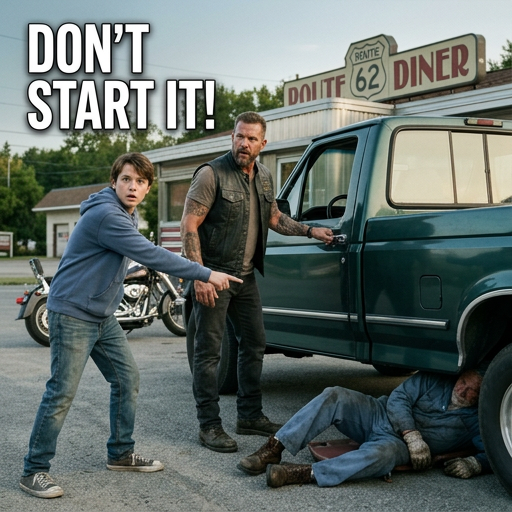
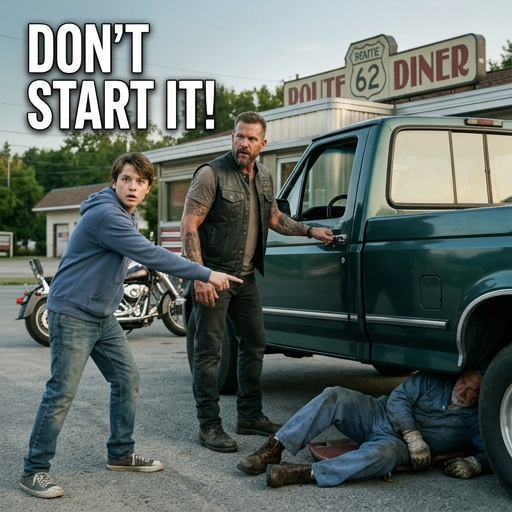
THE TEEN SLAMMED THE BIKER’S TRUCK DOOR SHUT — THEN YELLED “DON’T START IT!”
PART 1 — THE DOOR
Grant Barlow had one hand inside the pickup when the driver door slammed shut.
“Hey!”
He turned.
A teenage boy stood beside the truck.
The kid looked more frightened than defiant.
“DON’T START IT!”
Grant stared at him.
“Why?”
The boy pointed underneath the rear side of the pickup.
“He’s under there.”
Grant followed his finger.
Two worn work boots were sticking out beside the truck.
Every trace of anger disappeared.
Grant crouched.
“Who the hell is that?”
A mechanic’s creeper rolled slowly outward.
An older man appeared.
Gray stubble.
Faded coveralls.
Old work gloves.
Before he could answer, the teenager spoke.
“He fixed my mom’s car.”
A beat.
“For free.”
PART 2 — THE SOUND
The older man’s name was Curtis Vale.
Grant had never seen him before.
Curtis sat upright beside the truck.
Grant looked from him to the worn tool roll.
“Why were you under my pickup?”
Curtis shrugged.
“Heard something loose when you pulled in.”
Grant glanced toward the truck.
Then back at Curtis.
“You a mechanic?”
Curtis’s answer came quietly.
“Was.”
Grant heard the past tense.
“Got a shop?”
Curtis did not answer.
The teenager did.
“He sleeps behind one.”
Grant frowned.
“Whose shop?”
Curtis looked down at his gloves.
Then said:
“Used to be mine.”
PART 3 — MASON
The teenager was Mason Reed.
Fifteen years old.
His mother, Dana, cleaned offices at night and worked grocery checkout on weekends.
Their car was eighteen years old.
Every new noise meant another calculation.
Rent.
Food.
Electric bill.
Repair.
Pick three.
Three months earlier, the car stopped running outside a supermarket.
Dana sat behind the wheel trying not to cry.
Mason stood beside her searching repair shops on his phone.
Then an older man with a canvas tool bag walked across the parking lot.
Curtis.
He listened.
Looked.
Worked for almost forty minutes.
Then the engine started.
Dana asked what she owed him.
Curtis shook his head.
“Get the kid home.”
She tried again.
He refused.
Mason never forgot him.
PART 4 — VALE AUTOMOTIVE
Curtis had once employed six people.
Vale Automotive opened when he was thirty-one.
Two service bays became four.
Four became six.
Curtis remembered customers’ names.
Remembered their kids.
Remembered which people could afford repairs and which people needed another week.
The shop never made Curtis rich.
It made him useful.
He loved that.
Then his wife Marianne became ill.
At first Curtis kept working.
Then appointments became hospital visits.
Hospital visits became long stays.
Curtis gave more responsibility to employees.
Business slowed.
Expenses did not.
He borrowed against the building.
Then borrowed again.
Every decision made sense individually.
Together they consumed everything.
PART 5 — THE SALE
Curtis eventually sold the property.
The buyer allowed the repair business to continue there under a new lease.
Curtis thought that would solve things.
It did not.
Marianne became worse.
Curtis missed more days.
The lease fell behind.
Curtis sold equipment.
Then the business name.
Then his house.
Marianne died eleven months after the building changed hands.
Curtis was sixty-two.
He had spent his adult life fixing things.
After the funeral, he discovered he had no idea how to repair his own life.
PART 6 — BEHIND THE SHOP
The new owner of the garage knew Curtis’s history.
He occasionally allowed him to sleep in a small storage area behind the building.
It was not an apartment.
It was not permanent.
Curtis understood that.
During the day, he walked around town.
Sometimes he helped at the shop.
Sometimes he repaired lawn equipment.
Sometimes he fixed cars for people who clearly could not afford him.
He rarely charged them.
Mason once asked why.
Curtis answered:
“If I start charging people who don’t have money, neither of us gets anything useful out of the afternoon.”
Mason thought that was ridiculous.
He also admired it.
PART 7 — GRANT’S TRUCK
Grant had stopped beside the diner to pick up a box of motorcycle parts from a friend.
Curtis heard the pickup before he saw Grant.
A faint dragging metallic sound.
Curtis walked closer.
Grant parked.
Turned off the engine.
Then went inside for less than five minutes.
Curtis crouched beside the rear of the truck.
He wanted only to see whether something obvious was hanging loose.
Mason happened to be nearby waiting for his mother.
He recognized Curtis.
Then Grant returned.
Curtis was still partially beneath the rear side.
Grant opened his door.
Reached inside.
Mason saw Curtis’s boots.
Saw Grant’s hand moving toward the ignition.
He ran.
The truck door slammed.
“DON’T START IT!”
PART 8 — THE OFFER THAT DIDN’T COME YET
After hearing Curtis’s story, Grant did not immediately reach for his wallet.
Curtis noticed.
He appreciated it.
People who learned he had nowhere stable to live often changed the way they spoke to him.
Their voices became softer.
Their faces became sadder.
Grant did neither.
Instead he asked:
“You still any good?”
Curtis almost smiled.
“At what?”
“Cars.”
Curtis looked offended.
Mason laughed.
Grant laughed too.
That was the first moment the conversation felt normal.
PART 9 — MONDAY MORNING
Grant did not own a repair shop.
His friend Len did.
Grant called him that evening.
He did not tell Len to hire Curtis.
He said:
“I found an old mechanic who thinks he knows everything.”
Curtis, sitting nearby, corrected him.
“I know most things.”
Grant repeated that into the phone.
Len told them to come Monday.
No promises.
Curtis agreed.
Monday morning, a customer brought in a truck with an intermittent problem that two people had already failed to diagnose.
Curtis listened.
Asked three questions.
Then found the issue.
Len stared at him.
Curtis shrugged.
“Old truck.”
That afternoon Len asked if he wanted to come back Tuesday.
PART 10 — BEHIND THE SHOP
Curtis did not rebuild his old life overnight.
There was no miracle.
He worked three days the first week.
Four the next.
A local program eventually helped him find a small room.
He paid rent himself.
That mattered to him.
Mason continued visiting.
Curtis taught him how to listen to machines before touching them.
Grant stopped by mostly to insult Curtis’s coffee.
Several months later, Mason asked Curtis whether he missed Vale Automotive.
Curtis looked toward the old building across town.
“Every day.”
“Would you want it back?”
Curtis thought for a while.
Then shook his head.
“I wanted my life back.”
“That’s different.”
Mason understood.
The story people liked telling was simpler.
A kid slams a biker’s truck door.
A homeless mechanic rolls out.
The biker gives him a second chance.
But Grant remembered a different moment.
He remembered asking:
Got a shop?
And Mason answering:
He sleeps behind one.
Then Curtis saying:
Used to be mine.
That sentence contained an entire life Grant could not see from the parking lot.
A business.
A wife.
A collapse.
A man who had lost almost everything except the thing his hands still knew how to do.
Grant did not save Curtis.
Mason did not save him either.
They noticed him.
They listened.
And eventually somebody gave his skill another place to matter.
Sometimes that is how a person begins again.
Not with a miracle.
Not with charity.
But with one ordinary morning when somebody finally asks:
You still any good?
WATCH THE FULL VIDEO
Video is ready to play. If one link doesn't work, try another available link below 👇
WATCH THE FULL VIDEO
Video is ready to play. If one link doesn't work, try another available link below 👇